Is Remotion worth it for SaaS feature and launch videos?
An honest read: Remotion is excellent when video is a feature of your product, and a heavy way to make a one-off marketing asset. The licence, the Lambda bill and the engineering time, and how to tell which side you are on.
The question tends to come from someone who has just spent a day setting Remotion up for a single feature video and is not sure the day was well spent. The honest answer depends on one distinction.
The distinction: product feature or marketing asset
Video as a feature of your product. Per-user personalised videos, rendered on demand, at volume, inside your app. A render pipeline you own. This is a library job, and Remotion is very good at it.
Video as a marketing asset. A launch video, a changelog clip, an animated stat for a post. You make it a handful of times a quarter, and it has to look good this week. Writing React components to produce one is usually the expensive route.
If you are on the first side, stay. If you are on the second, read on.
What Remotion is genuinely better at
Even HyperFrames' own comparison page says this plainly, and it is worth repeating: Remotion is older and much more established, with more templates, more tutorials, more answered questions and far more production history. Remotion Lambda in particular is a mature, heavily documented rendering system. If your team already writes React you get your components, design system and charting libraries for free, with nothing to translate. And its model is simpler to hold in your head: one pure function of the frame number, no timeline to register.
What it costs, honestly
Licence. Free up to three people. At four or more, $25 per seat per month for creators, or $0.01 per render with a $100 monthly minimum if you automate rendering. Stills count as renders. See the licence in full.
Compute. Remotion publishes real numbers. On a 2048 MB Lambda in us-east-1: the Hello World composition is about $0.001, a one minute video about $0.017 warm and $0.021 cold, a ten minute HD remote video roughly $0.10 to $0.11, and a ten second 4K video about $0.013 to $0.014. Two caveats from Remotion's own docs: prices vary with region and bundle, so they recommend measuring your own composition, and estimatePrice() explicitly excludes S3 and Remotion licensing fees. Data transfer for large assets is billed separately and can add up. For a launch video you render a few times, compute is noise.
Time. This is the real cost for marketing video, and it does not appear on any pricing page. Authoring in React, debugging delayRender timeouts, tuning concurrency, fighting a Lambda quota of 10, soft text on high-density screens. None of these are defects in Remotion. They are the cost of owning a rendering pipeline, which is worth it when video is your product and a detour when it is your launch.
A quick way to decide
| If you... | Lean towards |
|---|---|
| Render per-user video inside your product | Remotion |
| Have a React team and want your components in video | Remotion |
| Need CI-driven or self-hosted rendering at scale | Remotion |
| Need a few launch or feature videos a quarter | A studio, or an HTML-based tool, not a pipeline |
| Want to hand the authoring to an agent | An engine built for it |
| Have under four people and little volume | Remotion is free, and may well be enough |
If you decide to move
Remotion compositions can be ported. HyperFrames ships a skill that reads a Remotion composition and rewrites it as HyperFrames HTML, and is candid about what it will not translate. See how to port a Remotion composition to HyperFrames, and the wider comparison of alternatives.
Check it worked
Write down how many videos you will render per month and who authors them. If the answer is "a few, and the same two people", you are making marketing assets. If it is "thousands, triggered by users", you are building a feature.
The studio route for launch videos
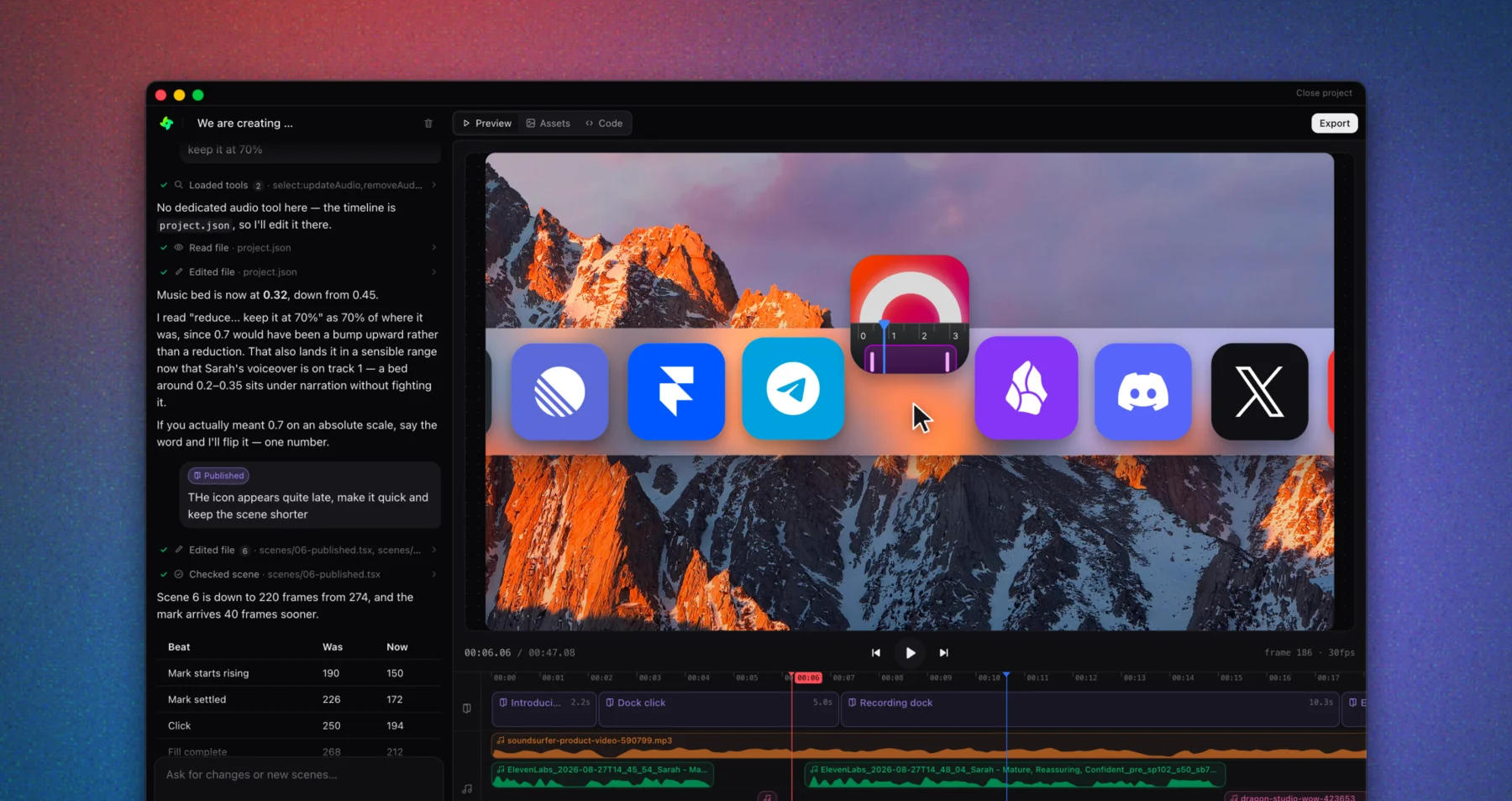
For the launch videos and feature announcements this answer is about, GenMotion is built the other way round from a pipeline: describe the video, direct the agent, refine it in a live preview, and export the MP4 on your own machine. There is no React to write and no render to orchestrate. If video is a feature of your product, stay on Remotion. Remotion alternatives, compared honestly.
Related answers
Do I need a Remotion Company License, and what counts as a render?
Free for teams of up to three people. At four or more you need a Company License, and if you automate rendering you need the per-render Automators plan, with a $100 monthly minimum. Stills count as renders. Studio previews do not.
Why is my Remotion render slow, and why does more concurrency make it worse?
Concurrency is not a dial you turn up. Too high and too low are both slow. Remotion's own performance guide, in order: video tag, concurrency benchmark, GPU effects, slow JavaScript, data fetching, codec, resolution, and Lambda.
What does 'TooManyRequestsException: Rate Exceeded' mean on Remotion Lambda?
You hit your AWS Lambda concurrency limit. New AWS accounts are sometimes capped as low as 10. How to render anyway with concurrency set lower, see your limits, and request an increase.
How do I port a Remotion composition to HyperFrames, and what will not translate?
HyperFrames ships a skill that rewrites a Remotion composition as HTML and grades its own output. It translates roughly 80 percent mechanically, and refuses state-driven animation and React UI kits rather than guessing. How to run it and what to expect.
How to create a product launch video with Remotion
Build a 12 second, four scene product launch video in Remotion: scaffold, fonts, one React component per scene, Studio, stills and a real render. Every file and command was run on Remotion 4.0.533.