Why is my Remotion render slow, and why does more concurrency make it worse?
Concurrency is not a dial you turn up. Too high and too low are both slow. Remotion's own performance guide, in order: video tag, concurrency benchmark, GPU effects, slow JavaScript, data fetching, codec, resolution, and Lambda.
If you came here from an issue titled "Remotion is too slow to use in production", the honest answer is that rendering video is one of the heaviest workloads a computer can take on, and Remotion aims to perform comparably to traditional video editing software. Your result also depends on your code and your hardware. These are the levers in Remotion's own guide, in the order to try them.
1. Use the right video tag
Use <Video> from @remotion/media for the best video performance. Both <Html5Video> (formerly just <Video> from the remotion package) and <OffthreadVideo> are not optimised. If you are still on an old tag, migrate.
2. Find the right concurrency, do not guess
npx remotion benchmark
The --concurrency flag can speed a render up or slow it down. Too high is counterproductive, because the browser tabs compete for CPU and memory, which also produces page function timeouts. Too low leaves cores idle. The benchmark command tries values and reports the best one for your machine.
3. Watch the GPU effects
These all use the GPU: WebGL content (Three.js, Skia, p5.js, Mapbox), 2D canvas graphics, and GPU-accelerated CSS such as box-shadow, text-shadow, linear and radial gradients as background-image, filter: blur() and filter: drop-shadow().
Cloud compute instances have no GPU and can take a long time to render them, which becomes the bottleneck. Replace the effect with a precomputed image where you can.
4. Find slow JavaScript
Render with --log=verbose, which lists the slowest frames, and use console.time around suspicious work. Use useMemo() and useCallback() to cache expensive computation. The first frames in a thread can be slow from initialisation, so look past those.
5. Measure your data fetching
Measure the impact of external resources, look for overfetching, and cache in local storage where you can to reduce time on the network.
6. Pick the codec and format with speed in mind
- Image format
pngis slower thanjpeg, butpngis required for a transparent video. - The WebM codecs
vp8andvp9are very slow to encode because of stronger compression.
H.264 is the default and rated very fast to encode. See the encoding guide for every tradeoff.
7. Lower the resolution
Higher resolutions make the render slower. If you can live with less, scale down with --scale. (If text looks soft, go the other way: see blurry text in exported video.)
8. If it is Lambda or Cloud Run
Lambda splits a video into chunks rendered concurrently. By default Remotion picks a framesPerLambda of at least 20, scaling concurrency from 75 to 150 across the first ten minutes at 30 fps. The limits are a minimum framesPerLambda of 5 and a maximum concurrency of 200, and beyond roughly that point more functions do not make a render faster. Set framesPerLambda to null and let Remotion choose.
Two more things people mistake for slowness:
- A new AWS account can have a concurrency limit as low as 10, which makes distributed rendering look broken. See the rate limit answer.
- A single chunk waiting on a slow remote media file holds up the whole render. See stuck renders.
Cloud Run renders a video inside one instance rather than distributing chunks. One report measured about five minutes for a 10 second video on the default 1 CPU instance, and found that assigning up to 8 CPUs per instance sped it up but reduced how many videos could render at once.
Check it worked
Change one thing at a time and re-run npx remotion benchmark or a short render with --log=verbose, so you know which change paid off.
Keep the pipeline out of the picture
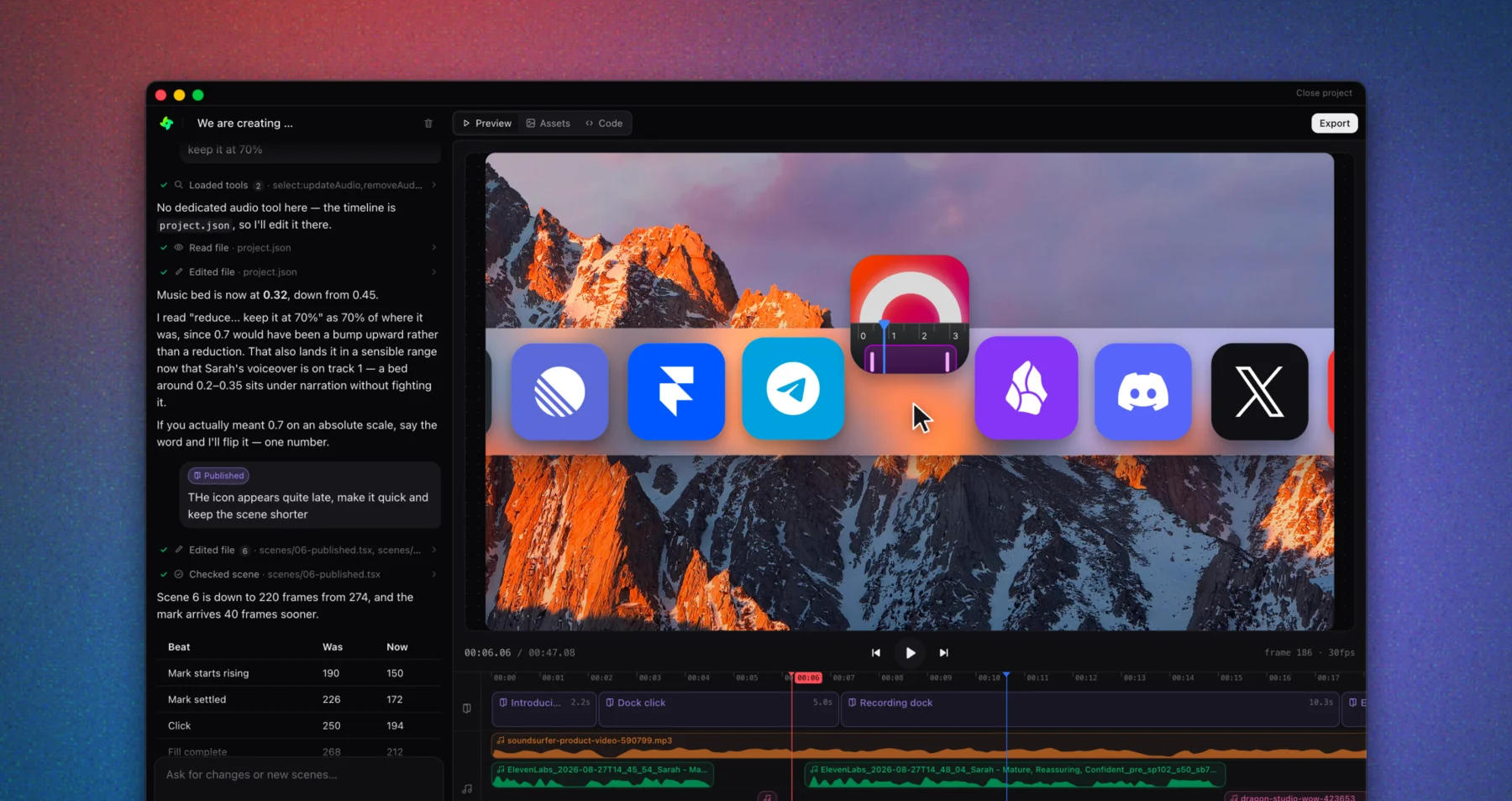
Tuning concurrency, codecs and Lambda is the price of owning a rendering pipeline, and it is worth paying when video is your product. If it is not, GenMotion lets you describe the video, refine it in a live preview and export once on your own machine, with no pipeline to tune. GenMotion does not render Remotion projects: it builds Three.js and HyperFrames videos. Remotion alternatives, compared honestly.
Related answers
What does 'Timed out evaluating page function' mean in Remotion?
It looks like a delayRender problem and it is not. The browser stopped responding because it is overloaded. The fix is usually to lower concurrency, not to hunt for an uncleared handle.
Why is my Remotion render stuck, and what do I check first?
A Remotion render that hangs at a percentage, or at the last frame, with no error. Four checks in order: a delayRender longer than your Lambda timeout, verbose logs, Chrome Headless Shell, and the Lambda errors field.
What does 'TooManyRequestsException: Rate Exceeded' mean on Remotion Lambda?
You hit your AWS Lambda concurrency limit. New AWS accounts are sometimes capped as low as 10. How to render anyway with concurrency set lower, see your limits, and request an increase.
Is Remotion worth it for SaaS feature and launch videos?
An honest read: Remotion is excellent when video is a feature of your product, and a heavy way to make a one-off marketing asset. The licence, the Lambda bill and the engineering time, and how to tell which side you are on.
Do I need a Remotion Company License, and what counts as a render?
Free for teams of up to three people. At four or more you need a Company License, and if you automate rendering you need the per-render Automators plan, with a $100 monthly minimum. Stills count as renders. Studio previews do not.
Sources
- Remotion: Performance tips
- Remotion: Lambda concurrency
- Remotion: Encoding guide
- remotion#4783: Remotion is too slow to use in production
This answer as plain Markdown, for agents: /answers/remotion-render-is-slow.md