How do I port a Remotion composition to HyperFrames, and what will not translate?
HyperFrames ships a skill that rewrites a Remotion composition as HTML and grades its own output. It translates roughly 80 percent mechanically, and refuses state-driven animation and React UI kits rather than guessing. How to run it and what to expect.
There is a real migration path. HyperFrames ships a remotion-to-hyperframes skill that reads a Remotion composition's source and rewrites it as a HyperFrames HTML composition, with the same frames, timing and output, running on GSAP instead of React's frame-callback model. It is one-way, and it is honest about what it will not do.
Is it worth it?
Decide that first. HyperFrames' own comparison page is candid that Remotion is older, more established and simpler to hold in your head, and says to migrate because your source material or team fits better on the other side, not because one framework looks newer. If your composition is mostly web material, HTML and CSS and a GSAP or Lottie animation, it ports close to as-is. If it is a tangle of React state and a UI kit, it will not. See whether Remotion is worth it.
How to run it
Install the skill, then ask your agent:
npx skills add heygen-com/hyperframes --skill remotion-to-hyperframes
/remotion-to-hyperframes Port the composition at src/HeroReveal.tsx
(Remotion project root: .) to HyperFrames. Keep the same duration, fps,
and dimensions. Write TRANSLATION_NOTES.md for anything that doesn't
translate cleanly. After translating, render both the Remotion original
and the HyperFrames version and report the SSIM diff.
Name the exact file, because a Remotion project can register several <Composition>s and the agent needs to know which one you mean. If the install itself fails, see the install answer.
The workflow only fires on an explicit request to port, convert, migrate or translate real Remotion source. "Make something like my Remotion video" is a fresh build, not a migration.
What translates
Roughly 80 percent of a typical composition translates mechanically. The skill maps useCurrentFrame and interpolate onto timeline tweens, Sequence onto clips, and converts frames to seconds.
What will not, and why refusing is correct
The skill lints the source before translating anything. It refuses rather than approximates when it finds something HyperFrames' seek-driven model cannot represent deterministically:
- State-driven animation.
useState,useReducer, oruseEffectanduseLayoutEffectwith real dependencies. HyperFrames expects the same pixels every time for a given frame, and a state machine that reacts to its own history cannot promise that. You get an interop recommendation instead of a plausible but wrong translation. - Third-party React UI kits. MUI, Chakra, Mantine, antd, shadcn, Radix, NextUI. There is no HTML, CSS and GSAP equivalent to translate them into.
@remotion/lambdadeploy config. Not a blocker. It is dropped, because it is deployment configuration rather than animation, and the rest of the composition still translates.- Async metadata is also flagged rather than silently mistranslated.
If your source hits a blocker, expect the agent to stop and explain. That is the correct behaviour, not a failure. Do not tell it to "just convert it and not worry about the state stuff": the result looks right and is not frame-accurate.
The one habit that matters: validate
Ask for the SSIM diff every time you port something non-trivial. A visual-only check misses timing and easing drift that only shows up in a frame by frame comparison. Also ask for TRANSLATION_NOTES.md, so approximated fonts, dropped volume ramps and substituted presentations are written down instead of absorbed.
After the port
A ported composition is an ordinary HyperFrames project, so the rules apply. Read the determinism checklist, because HyperFrames asks you to follow rules (a paused timeline, no wall clock, no unseeded randomness) and breaks quietly if you do not, which Remotion's model does not. Also note the licence difference: HyperFrames is Apache 2.0, with no seat count and no per-render fee, while Remotion's licence depends on headcount and render volume.
Check it worked
Render the ported composition and the original, extract a frame at the same three times from each (first, middle, last), and compare them. Then read TRANSLATION_NOTES.md end to end before you delete anything.
Or skip the port and describe the video
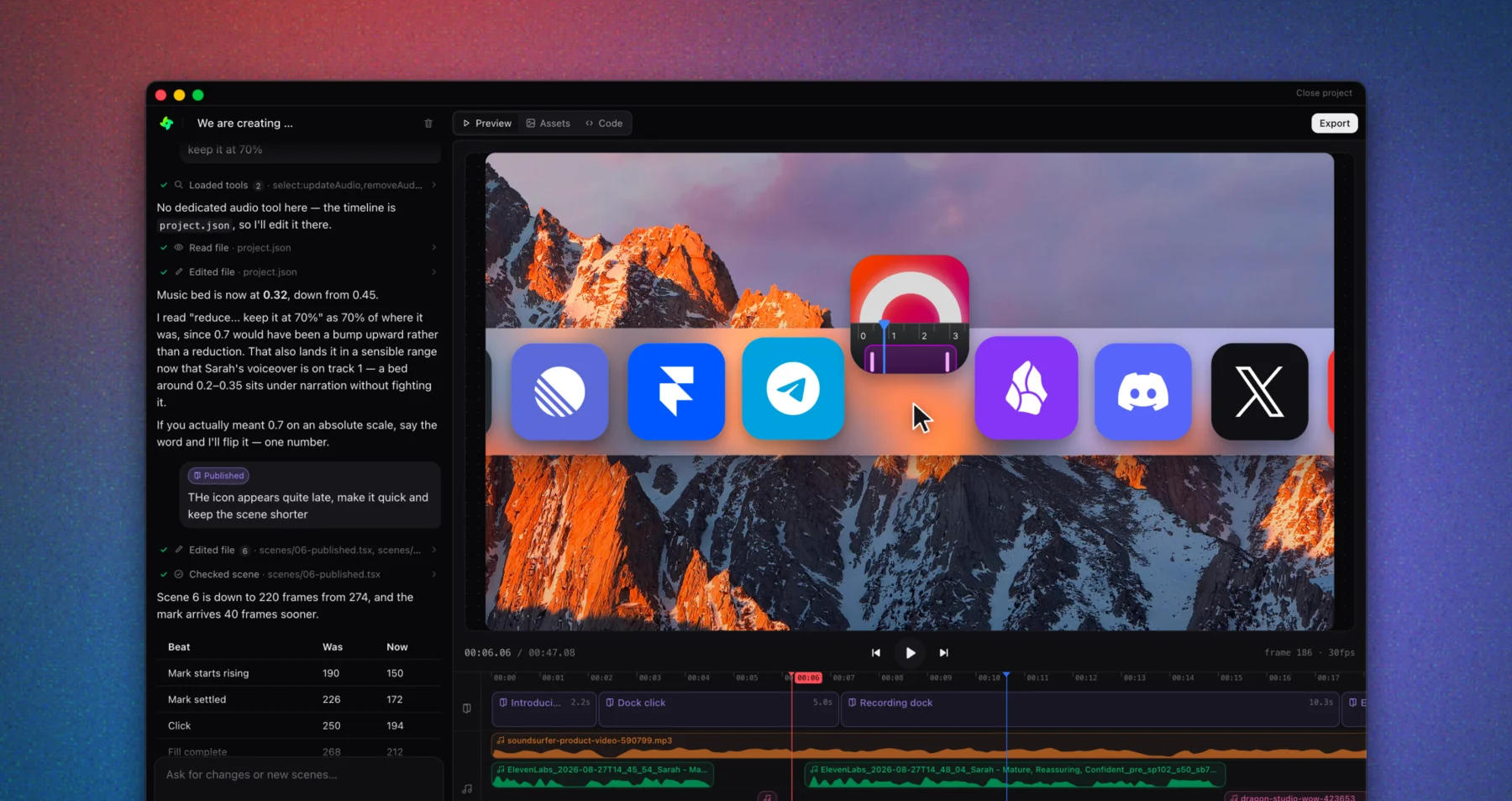
GenMotion does not read Remotion projects. If the video is one you can describe, you can skip the port entirely: tell the studio what it should show, and it builds the scenes as a HyperFrames project, previews them frame by frame and exports on your own machine. How the HyperFrames engine works in GenMotion.
Related answers
Is Remotion worth it for SaaS feature and launch videos?
An honest read: Remotion is excellent when video is a feature of your product, and a heavy way to make a one-off marketing asset. The licence, the Lambda bill and the engineering time, and how to tell which side you are on.
Do I need a Remotion Company License, and what counts as a render?
Free for teams of up to three people. At four or more you need a Company License, and if you automate rendering you need the per-render Automators plan, with a $100 monthly minimum. Stills count as renders. Studio previews do not.
What are the HyperFrames determinism rules, in one checklist?
Same composition, same video, every time, as long as nothing in a frame reads the clock, an unseeded random number or the network. The rules, the reason for each, and the lint codes that enforce them.
How do I install HyperFrames, and why did npx skills add fail?
The current install routes for Claude Code, Codex, Cursor and others, plus the three real failures people hit: a 60 second clone timeout, a missing git-lfs, and a Codex marketplace error. What each means and how to get past it.
Sources
This answer as plain Markdown, for agents: /answers/port-remotion-to-hyperframes.md