Why does my HyperFrames video clip render black or freeze?
A video clip that plays in preview but renders black usually needs its own data-start and data-duration, not just a timed wrapper. Also covers clips shorter than their slot and videos that freeze while their box animates.
Three different things produce a black video clip, and they look identical from the outside.
Cause 1: the video has no timing of its own
This is the one that catches people, including the maintainers. In a report titled "video clip renders black when placed later in the timeline than its source duration", a 4 second source rendered black once the clip was placed later in the timeline than the source's own length. The maintainer who filed it later closed it with this note: the composition was wrong, not the renderer.
The wrapper had the timing. The <video> did not.
<!-- Black once data-start passes the source length -->
<div class="clip" data-start="6.0" data-duration="2">
  <video src="public/c.mp4"></video>
</div>

<!-- Renders correctly -->
<div class="clip" data-start="6.0" data-duration="2">
  <video src="public/c.mp4" data-start="6.0" data-duration="2"></video>
</div>
Same source, same composition, same data-start. Measured by averaging each frame to a single pixel: the first version was 000000 at 6.2, 7.0 and 7.8 seconds; the second showed content at all three. Without its own timing, the element's schedule starts at composition zero, so by 6 seconds it is past the end of a 4 second source.
Fix: put data-start and data-duration on the <video> itself.
Cause 2: the source is shorter than its slot
If the file is shorter than data-duration and the video has no loop attribute, older versions held the last frame in Studio preview (the browser's native behaviour) but rendered black for the remainder. That was reported against 0.6.38. A later report that a bare <video> disappears after the file ends while preview keeps the last frame was closed in August 2026.
Fix: make data-duration match the real length of the file, add loop if you want it to repeat, or trim the slot. Check the source length with ffprobe before you pick the duration.
Cause 3: the video froze, or only the box moved
Do not animate width, height, top or left directly on a <video> element. The picture freezes while the box animates. Put the video inside a wrapper and animate the wrapper:
<div id="video-wrapper">
  <video src="./assets/video.mp4" style="width:100%;height:100%"></video>
</div>
tl.to("#video-wrapper", { width: 500, height: 280, x: 1200 }, 2);
Never call play(), pause() or set currentTime from a composition script either. HyperFrames owns media playback, and doing it yourself makes media play out of sync.
If the video is black in preview but renders
That is a codec problem rather than a timing one. The browser may not decode a source that FFmpeg can. HyperFrames normally builds a compatible preview proxy. If the frame stays black, check that automatic proxying is not disabled, run npx hyperframes doctor, and run npx hyperframes lint --verbose to list the affected files.
Check it worked
npx hyperframes snapshot --at 0,6.5,7.5
Sample a time inside the clip's own window, not just at the start. Frame zero will look fine in every version of this bug.
Describe the clip, skip the timing attributes
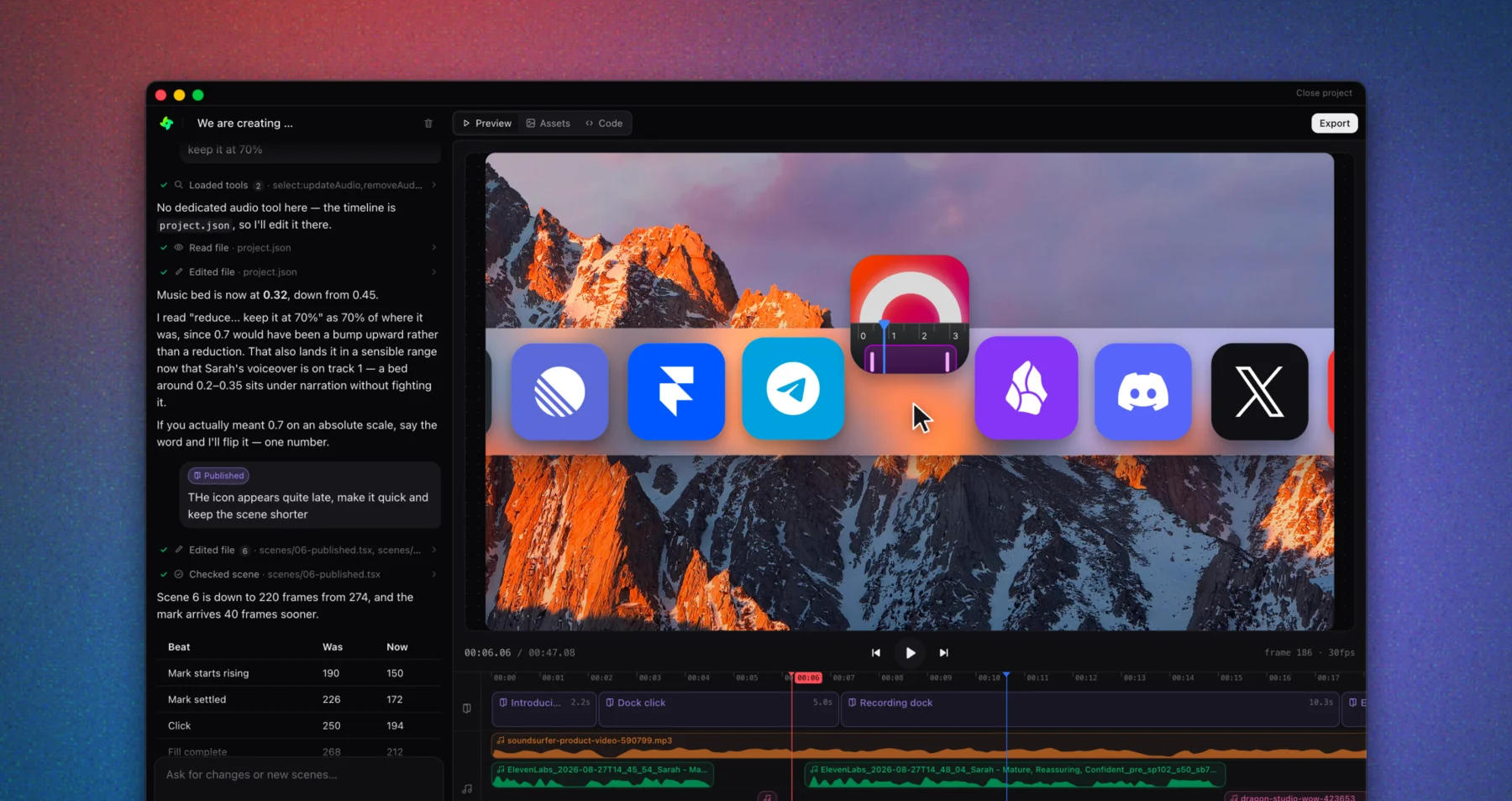
In GenMotion you say where a clip goes and for how long, and the agent writes the HyperFrames timing for it, working from the HyperFrames skills it ships with. Before it reports back it can capture frames from inside the clip's window and look at them, so a clip that would render black is caught while you can still change it. Footage and audio live in the project's assets folder, in a project you own.
Related answers
Why is my HyperFrames render black?
A black HyperFrames video almost always has one of seven causes, from rendering the wrong entry file to a video clip with no timing of its own. Here is how to tell which one you have in a few minutes.
Why did HyperFrames check pass and render exit 0 when my video is wrong?
HyperFrames can produce a valid-looking MP4 from a composition that is structurally fine and visually wrong. Here is the class of bug, what has been fixed to fail loudly, and what to verify yourself.
Why does my HyperFrames render look different from the preview?
Preview and render run the same runtime, so a real difference has a specific cause: fonts, remote media, a cold-seek state problem, the wrong entry file, or a variable that never arrived. Here is how to find which.