Why does every HyperFrames render take 45 seconds longer than it should?
A composition that never registers a GSAP timeline still makes the renderer wait for one, and gives up after a fixed 45 seconds. The cost is flat on every render. One attribute removes it.
missing_data_no_timeline
sub_timeline_readiness_timeout
You have a short composition. It should render in seconds. Every render sits for most of a minute doing nothing first, and no setting you change makes the wait shorter.
Why it happens
The producer decides a composition is ready by polling for window.__timelines[<id>] until the composition player reports ready. If nothing ever registers, it gives up after player-ready-timeout, which defaults to 45 seconds. That wait is a fixed cost paid on every render. It does not scale with quality, resolution or media size, so lowering any of those cannot reduce it.
A composition with no GSAP timeline at all, because it is static, a still image, or built from video and audio only, has nothing to register. So it pays the full wait every time.
Fix: declare that there is no timeline
<div
  data-composition-id="promo"
  data-no-timeline
  data-width="1920"
  data-height="1080"
  data-duration="6"
></div>
data-no-timeline tells the renderer not to wait. npx hyperframes lint reports the omission as missing_data_no_timeline, so it is easy to find.
If you do want an animation, register a timeline instead of skipping the wait: see why an animation can be static.
Other ways to pay the same bill
Registering the timeline too late. If a timeline is created inside an async function or a .then(), it is not in window.__timelines when the producer first looks. The wait then runs to the timeout. This is documented as a bug in several registry blocks: the map blocks fetch their topology data from a CDN at render time and build their whole timeline inside the async callback, and a device-mockup block registers its timeline inside an async ready handler. Both stall for 45 seconds and fall back to screenshot capture. That report is still open, so if you use those blocks, expect it.
A script that throws. If the composition script errors before building the timeline, the timeline never registers and you pay the wait, then get a video that never moved. See why the first render can be a still image.
Static sections that are not marked. A bare data-composition-id host used for a static section was reported as burning the full player-ready budget on every render, for the same reason.
Check it worked
time npx hyperframes render --quality draft --output review.mp4
Before the change the draft render takes about 45 seconds longer than the work it does. After it, the wait is gone. Then see the full list of reasons a render is slow for what is left.
Iterate in the preview, render once
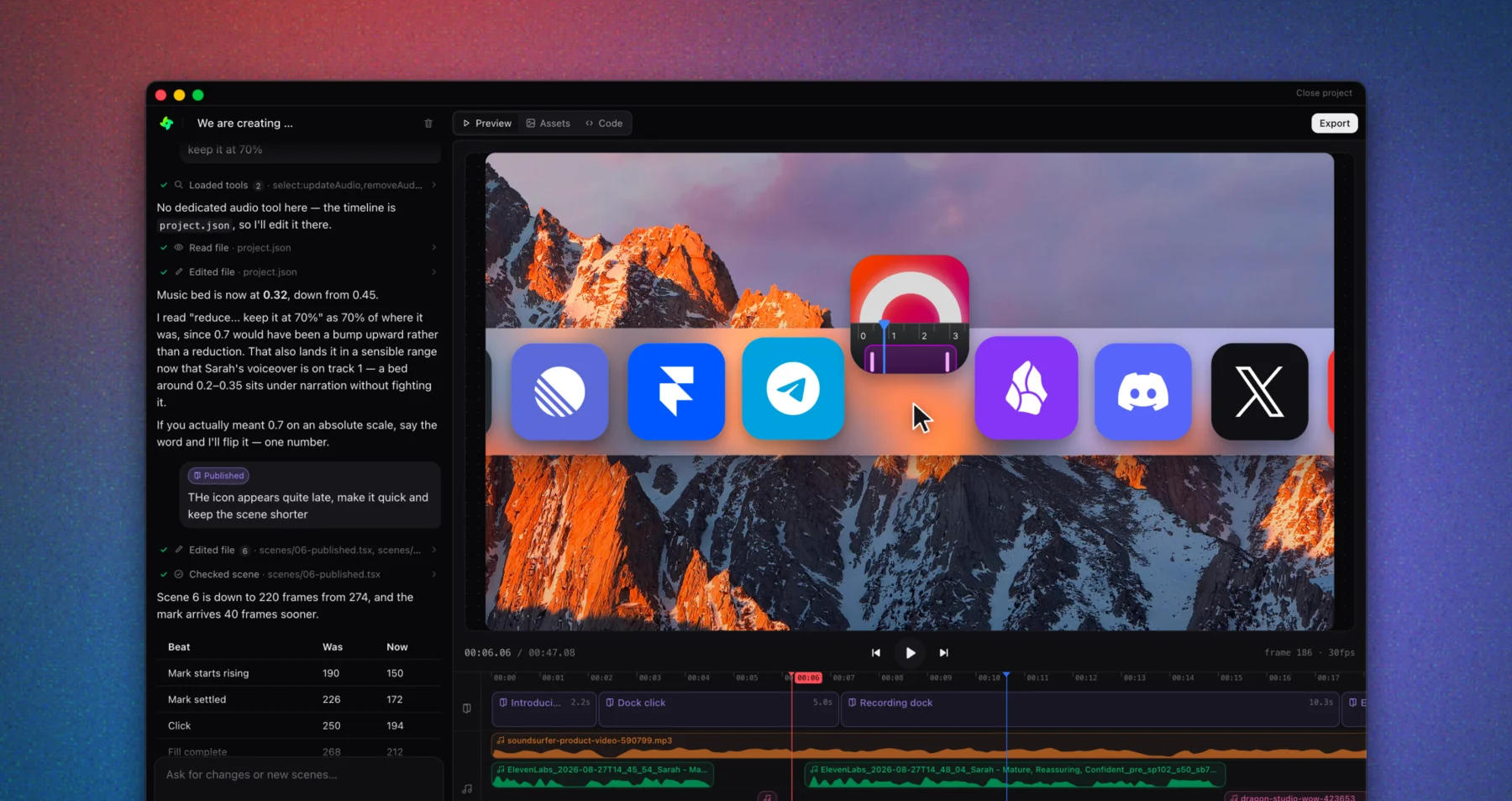
The studio compiles on every change and previews frame by frame, so most of your iterations never touch a render at all. The export, where a fixed wait hurts, happens once, on your own machine, driven from the project you already have open. Pick the HyperFrames engine when you start a project and describe the video.
Related answers
Why is my HyperFrames render slow, and what actually speeds it up?
Separate a slow preview from a slow render, find the fixed 45 second tax, then work through source video, filters, encoding and resolution. Real fixes from HyperFrames' own performance guide.
Why is my HyperFrames animation static?
If the render shows your elements frozen in their start state, HyperFrames almost certainly cannot find or seek your timeline. The timeline has to be paused and registered under the exact composition ID.
Why is my first HyperFrames video a still image?
A composition script that throws leaves the timeline unbuilt, and older HyperFrames versions waited 45 seconds, wrote the MP4 anyway and exited 0. Here is why that happens and how current versions fail instead.
How to create a product launch video with HyperFrames
Build a 12 second, four scene product launch video from an empty folder with HyperFrames: the project layout, every file, the check and snapshot commands, a real render, and the mistakes the linter catches. Tested on HyperFrames 0.8.134.